Strength training plateau? How to find the cause and start making progress again
Almost everyone who lifts long enough gets stuck at some point. Here's how to find out why your strength has stalled and what to change to get it moving again.
You hit a strength training plateau when the numbers in your log stop moving. The squat that climbed every week for months now sits at the same weight, your bench has been stuck for six weeks, and adding even a little more feels impossible. If that sounds familiar, you're in good company. Almost everyone who lifts long enough runs into this, usually more than once.
A plateau is rarely a mystery, though. It almost always comes down to a handful of things: how you load your training, how well you recover and how cleanly you move. This guide walks you through why it happens, how to troubleshoot it and what to change so you start making progress again.
Why strength stalls
As a beginner you get stronger almost every session. Much of that early progress comes from your nervous system learning the lifts and your body reacting to a completely new stimulus. After a few months those easy gains taper off, and every step forward takes more work, smarter planning and more patience.
So a plateau doesn't mean you're doing everything wrong. It means what used to work isn't enough anymore. The usual suspects:
- Running the same routine too long. Same exercises, same sets and reps, week after week. Eventually it stops being a new challenge.
- Volume that's off. Too few hard sets won't drive progress, but too many sets you can't recover from will hold you back just as much.
- Poor recovery. Short sleep, high stress or not eating enough means your body can't rebuild what training breaks down.
- Technique creep. As weights get heavy, form tends to slip, and the work shifts away from the muscles you're trying to train.
- No real plan for progression. Without a rule for when and how much to add, progress becomes random.
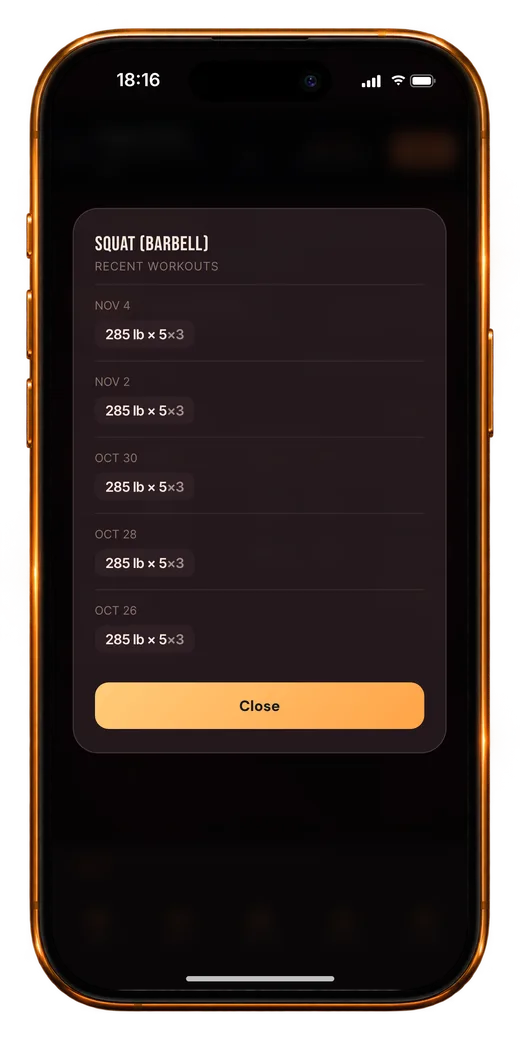
How to troubleshoot a strength training plateau
Before you jump to a new program or a new supplement, do an honest audit. Go through these one at a time. Most people find the culprit without having to change everything at once.
Check your training log
First, confirm you're actually stuck and not just feeling stuck. Look back six to eight weeks and compare weight, reps and how hard each set felt. You might have added reps without adding weight, or improved on one lift while another slipped backward.
If you don't track your training, start now. Write down the weight, the reps and ideally how many reps you had left in the tank (RIR). TANK logs weight, reps, rest and RIR for every set, which makes it easy to see whether everything has stalled or just one lift.
Look at your sleep and stress
Strength is built between sessions, not during them. If you're sleeping badly several nights a week, going through a rough patch at work or have a newborn at home, slower progress is to be expected. That's not failure, it's physiology.
Fix what you can: consistent bedtimes, less screen time late at night and not scheduling your heaviest session for the day after a short night. If poor sleep is a long-term problem, talk to your doctor.
Make sure you're eating enough
It's hard to get stronger while undereating. If you're in a cut, strength holding steady or dipping slightly is normal, and that isn't really a plateau at all. If your goal is to build strength, eat enough overall and spread your protein across several meals in the day.
You don't need to weigh every gram. But if you often train hungry or struggle to maintain your body weight, food is probably part of the answer.
Film your technique
Record your heaviest sets. Squat depth often gets shallower as the bar gets heavier, hips shoot up first on the deadlift, and the bar bounces off the chest on the bench. It looks like you're lifting more, but the load ends up in the wrong place and progress gets harder.
Compare a light set with a heavy one. Do they look the same? If not, drop the weight a little and build back up with clean reps.
Count your volume and effort
Tally up your hard sets per muscle group per week. If the number is low, a few extra sets may be all you need. If it's high and you feel beat up all the time, you're probably doing too much. Also look at how close to failure you train: if every set ends with lots of reps left, the stimulus may be too weak, and if every set is a grinder, fatigue may be eating your gains.
Practical ways to break through
Once you know the likely causes, start adjusting. Change one or two things at a time and give each change a few weeks. Otherwise you won't know what actually worked.
Switch your rep range
If you've been doing heavy fives forever, a block of eight to twelve reps can get things moving again, and the reverse works too. A common approach is four to six weeks of higher reps followed by a return to heavier sets. Many lifters come back stronger on their fives than before.
Another option is double progression. Pick a rep range, say 6–10. Add reps until you hit 10 on every set, then increase the weight and start again at 6.
Use smaller jumps
Going from 60 to 62.5 kg (roughly 135 to 140 lb) on the bench is an increase of more than four percent. That's a lot for a lift that's already grinding. Fractional plates of 0.5 or 1.25 kg (around 1 or 2.5 lb) let you add 1–2.5 kg (2–5 lb) at a time instead. This matters most on the bench press, overhead press and other upper-body lifts.
Rotate exercise variations
Swap in a close variation for a few weeks:
- Squat: pause squat or front squat
- Bench press: close-grip bench, paused bench or dumbbell press
- Deadlift: Romanian deadlift or block pulls
- Overhead press: seated dumbbell press
Variations train the same pattern with a slightly different stress and can bring up a weak point. Keep the main lift in the program at lower volume, or come back to it after the block.
Take a deload
A deload is a lighter week where you cut sets, weight or both. You still train, but you let accumulated fatigue fade. Many lifters feel noticeably stronger the week after. A simple version: halve your sets and leave a few reps in the tank on everything.
If you've been pushing hard for months without a break, a deload might be all it takes.
Rethink how you progress
Progress isn't only about adding weight. More reps, more sets, better control and shorter rest are all ways to increase the load. Our guide to progressive overload goes deeper if you want a clear system.

When to switch programs
Program hopping is one of the classic reasons people stall, because they never stick with anything long enough to see results. That said, sometimes a switch is the right call. Consider it when:
- you've followed the program consistently for at least two to three months and already sorted out sleep, food and technique,
- you're on a beginner program that adds weight every session and you can no longer keep up,
- your goal has changed, for example from pure strength to HYROX or running,
- the program doesn't fit your schedule and you keep missing sessions,
- you're bored and losing motivation. The program you actually follow beats the perfect one you skip.
If you switch, choose something that varies the load across weeks rather than just adding weight every time. TANK has 288 ready-made programs, and if you suspect your form is holding you back, you can film a set and get a score from 0 to 100 with rep-by-rep tips.
The bottom line
A strength training plateau is part of lifting long term. Start with your log, check sleep, food and technique, and count your volume. Then change your rep range, use smaller jumps, rotate variations and deload when you need it. Only switch programs once you've given the current one a fair shot. With patience and a plan, the numbers will start moving again.
Read next
Log your training, film your technique and see your progress. The workout log is free.
App StoreGoogle PlayFrequently asked questions
How long does a strength plateau usually last?
It varies a lot. If you haven't added weight or reps in four to six weeks despite training consistently, it's worth starting to troubleshoot.
Will taking a week off help me break a plateau?
Sometimes. A lighter deload week often does the same job without breaking your routine, but a full week off is fine too if you feel run down.
Can you get stronger while losing weight?
Beginners often can. For more experienced lifters, strength usually holds steady or dips slightly in a calorie deficit, and that's normal rather than a sign your training is wrong.
Should I train to failure to break through a plateau?
Not on every set. Going close to failure now and then can help, but taking every set to the limit builds fatigue that can slow your progress.