Resting Heart Rate and Training: What Your Morning Pulse Is Telling You
Your resting heart rate is a simple daily signal of how your body is coping. Here's how to measure it properly, why your own baseline matters most and how to adjust training when the number jumps.
Your resting heart rate is one of the simplest signals your body gives you. Track it for a few weeks and patterns start to appear: a higher number after a brutal leg day, after a short night, or a day before a cold kicks in. This guide covers resting heart rate and training in practical terms: what the number means, how to measure it properly and how to use it to adjust a session without letting it run your life.
It's written for people who lift, run or train for HYROX. It isn't medical advice, and it won't hand you a "normal" range to compare yourself against. If you're worried about your heart rate or how you feel, talk to a doctor.
What is resting heart rate?
Resting heart rate is the number of times your heart beats per minute when you're fully at rest, with no working muscles demanding extra blood. It's measured in beats per minute (bpm). The less work your heart has to do at rest, the lower the number tends to be.
It varies a lot between people. Age, genetics, body size, medication and fitness all play a part. Two equally fit people can have very different resting heart rates, and the one with the lower number isn't automatically fitter. That's why comparing yourself with a friend, or with a chart you found online, tells you very little.
Resting, morning and sleeping heart rate
These terms get used interchangeably. Morning heart rate is what you measure the moment you wake up, before getting out of bed. Sleeping heart rate is the low rate a watch records overnight. Resting heart rate is the broader term, and wearables usually calculate it from stretches of the day and night when you're still. Each brand does this slightly differently.
Which term you use matters less than measuring the same way every time.
How to measure it properly
If you're checking by hand or with a chest strap, first thing in the morning is best. Coffee, stress and moving around haven't had a chance to affect the number yet.
- Measure as soon as you wake up, before you get up or reach for your phone.
- Lie still and breathe normally for a minute.
- Find your pulse on the side of your neck or the inside of your wrist with two fingers, or read it off a chest strap.
- Count the beats for a full minute, or for 30 seconds and double it.
- Write it down, along with how you slept and how you feel.
If you had to get up for the bathroom or an alarm jolted you awake, lie back down for a few minutes and measure again. The odd strange reading isn't a problem, but it's easier to interpret when you know what caused it.
Using a watch or ring
A smartwatch or ring does the work for you. It measures every night without any effort on your part, which gives you more data points and a smoother trend. The catch is that wrist readings get less reliable when the strap is loose, so wear it snug and on the same wrist each night.
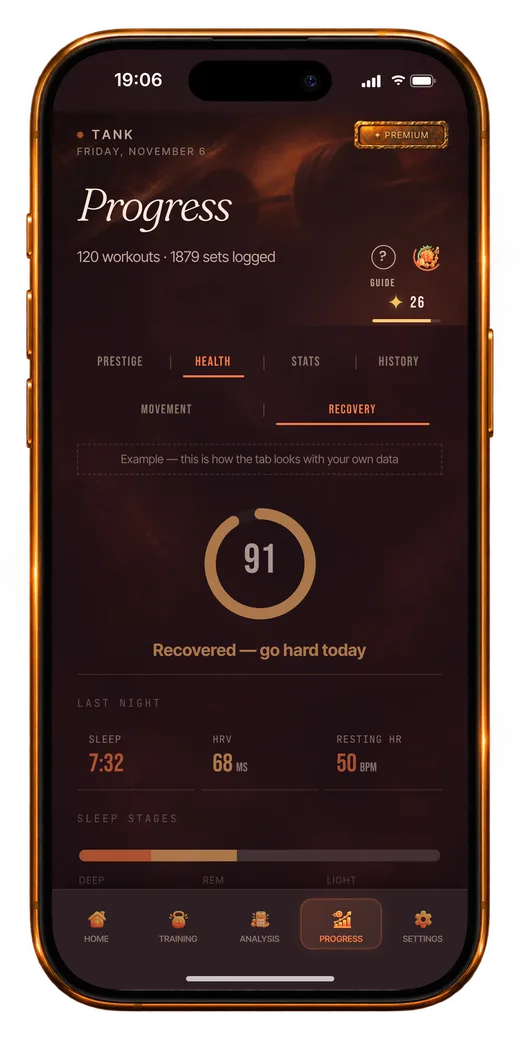
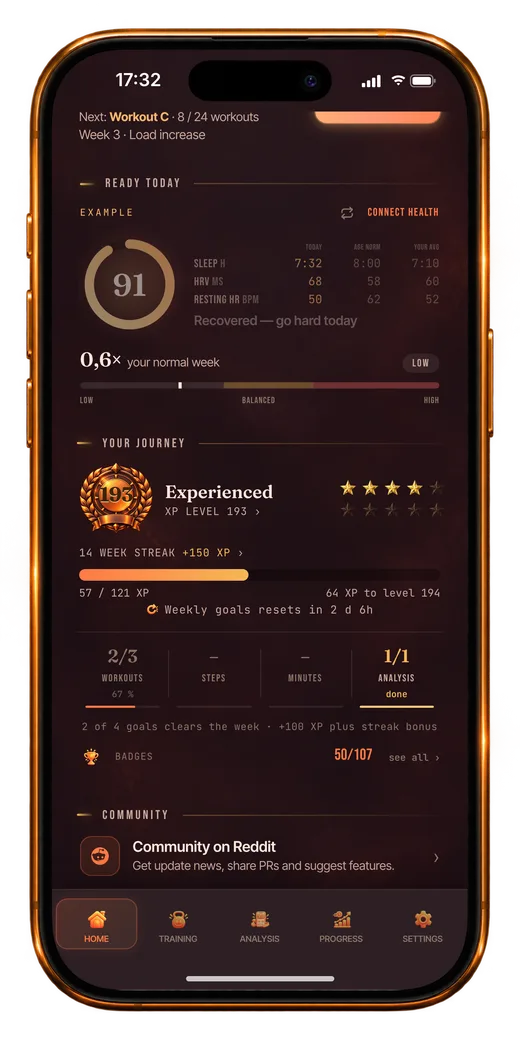
If you wear an Apple Watch, TANK pulls resting heart rate, HRV and sleep from Apple Health and shows a recovery score compared with your own average, so you can see at a glance whether this morning looks normal for you.
Why your own baseline beats any chart
A single reading says very little. What matters is how today's number compares with your usual level. If your resting heart rate is normally stable and suddenly sits clearly higher three mornings in a row, that's worth paying attention to. If it bounces up and down by a couple of beats, that's usually just normal day-to-day noise.
To build a baseline you can actually use:
- Give it a few weeks before drawing conclusions. That's when you get a fair picture of your normal.
- Watch the trend, not the day. A weekly average compared with the last several weeks is far more useful than yesterday's number.
- Note the context. A late night, a few drinks, travel, a heavy dinner or a hot bedroom can all push the number up without anything being wrong.
- Stick to one method. A watch reading and a manual count aren't directly comparable.
Over time you'll learn how your own body responds. Some people see a clear bump after heavy squats, others barely notice anything. Your history is what makes the number useful.
Why is my resting heart rate higher than usual?
There's almost always a reason. Here are the common ones in broad strokes. This isn't a diagnosis, just things worth thinking through.
Hard training
After a tough session or a big training week, your body is busy repairing muscle, refilling energy stores and settling down. That can show up as a slightly higher pulse the next morning, and it's a normal part of training. It only becomes a concern if it stays elevated day after day while you also feel run down, sleep badly and perform worse.
Poor or short sleep
One short or restless night often shows up straight away. Your body hasn't fully wound down, so your heart rate stays a little higher. String several bad nights together and the effect usually gets more obvious.
Getting sick
A raised resting heart rate is sometimes one of the first signs your body is fighting an infection, occasionally before you feel ill. If you have a fever, a sore throat, body aches or just feel off, skip hard training and rest until you're well.
Stress and everything else
Mental stress affects the same system that controls your heart rate, so a rough patch at work or broken sleep with a newborn can show up in the numbers. Alcohol the night before, not drinking enough, heat and jet lag are other common culprits.
Adjusting your training to your resting heart rate
The point isn't to let one number dictate everything. Weigh it against how you actually feel. When the number and your body point the same way, listen.
| Situation | What to do |
|---|---|
| Normal for you, you feel fresh | Train as planned. |
| Slightly higher, you feel fine | Start the session but be ready to scale back. Warm up well and check in with yourself. |
| Clearly higher, you feel tired | Swap to something easy: a walk, an easy run, mobility or light technique work. |
| Higher several days running | Look at sleep, stress and training load. Plan a lighter week. |
| Higher and you feel ill or have a fever | Rest. Don't train until you're better. |
Ways to dial it back
- Lifting: keep the exercises but drop a set or two, or leave more reps in reserve than usual. Skip heavy singles.
- Running: swap intervals for an easy, conversational run, or cut it short.
- HYROX and circuits: lower the intensity, take longer breaks between stations or do a technique session instead of a race simulation.
If you're following a structured plan, like a workout plan for beginners, moving a hard session back a day is completely fine. It beats grinding through it half-heartedly and digging a deeper hole.
Resting heart rate over the long term
For many people who do regular cardio, resting heart rate drifts down over months as the heart becomes more efficient. It's slow and varies between individuals, so don't use it as your only measure of progress. Faster times, heavier lifts and sessions that feel easier say just as much.
If, on the other hand, your resting heart rate creeps up over several weeks while training feels harder and your sleep gets worse, you may be training more than you're recovering from. An easier block is often the best fix.
When to see a doctor
Resting heart rate is a tool for planning training, not for diagnosing anything. Get checked out if you're worried, and especially if you have:
- chest pain, chest pressure or breathlessness that doesn't match the effort
- dizziness or feeling faint
- palpitations or a pulse that feels irregular
- a resting heart rate that's unusually high or low for you with no obvious reason
For urgent symptoms such as chest pain, call your local emergency number straight away.
Read next
Log your training, film your technique and see your progress. The workout log is free.
App StoreGoogle PlayFrequently asked questions
What is a good resting heart rate?
There's no single number that fits everyone, because age, genetics, medication and fitness all affect it. Compare yourself with your own average over a few weeks, and speak to a doctor if you're concerned.
Should I work out if my resting heart rate is high?
If it's only slightly up and you feel good, you can usually train but be ready to scale back. If it's clearly higher and you feel tired, go easy. If you're ill or have a fever, rest.
Why is my resting heart rate higher after a hard workout?
Your body is still recovering from the load, which can raise your pulse a little the next morning. It usually settles within a day or two.
When is the best time to check resting heart rate?
Right after waking, lying down and before you get out of bed. Measure the same way every time so the numbers are comparable.