How Often Should You Lift Weights? Finding the Right Number of Sessions
Two, three or five sessions a week? Here's a clear answer on how often to lift, based on your experience, your schedule and how well you recover.
How often should you lift weights to get stronger and build muscle? For most people the honest answer is two to four sessions a week. What matters more than the exact number is that each muscle group gets worked roughly twice a week, and that you can keep the schedule going for months rather than a couple of weeks.
This guide covers what you get from two, three, four or more sessions, how often to train each muscle, what suits beginners compared with experienced lifters, and how to decide based on your time and recovery. At the end you'll find sample weeks you can copy.
The quick answer
- Two sessions a week: enough for real progress, especially if you're new or busy. Train your full body both days.
- Three sessions a week: the sweet spot for most people. Enough practice to sharpen your technique, with plenty of rest in between.
- Four sessions a week: a good fit once you've been training for a while and need more volume without marathon workouts.
- Five or more: workable for experienced lifters who recover well, but rarely necessary to see results.
More sessions are not automatically better. Results come from the total amount of quality work you do, how you spread it across the week and whether you recover between workouts.
How often should you train each muscle?
It helps to think about frequency in two ways: how many times you go to the gym, and how many times each muscle group gets trained. The second number is the one that drives progress.
A common rule of thumb among coaches is to hit each muscle group about twice a week. Once a week isn't wrong, but say you plan to do twelve sets for your legs in a week. Splitting them into two sessions of six sets usually gives you better quality than grinding through all twelve in one go. The last few sets of a long session tend to get sloppy, and form is the first thing to slip.
Why spreading it out helps
- Fewer junk sets. More of your work happens while you're still fresh.
- More practice. A squat you rehearse twice a week becomes second nature faster than one you do once.
- Less soreness. Moderate doses usually leave you less sore than one huge dose, so your next session goes better.
Smaller muscles such as arms and calves also get indirect work: biceps during rows, triceps during presses. You don't need to account for every muscle down to the last set.
How often should beginners lift weights?
When you're new, almost any sensible program makes you stronger, largely because your nervous system is learning the movements. That's why consistency beats volume at this stage. Two or three full-body sessions a week is a great place to start.
Leave at least one rest day between sessions, for example Monday, Wednesday and Friday. Repeat the same core lifts several times a week: a squat pattern, a hip hinge such as a deadlift or hip thrust, a press, a row and some core work. Pick weights that leave a couple of reps in the tank on every set.
Don't panic if you're very sore during the first few weeks. It usually eases off as your body adapts. Three steady sessions a week for six months will take you much further than six brutal ones a week for three weeks followed by quitting.
Experienced lifters: when do more sessions pay off?
After a year or two, progress slows and you'll usually need more volume to keep moving forward. Adding sessions is often the most practical way to fit that volume in. Four one-hour workouts are easier to do well than three that drag on for 90 minutes.
With four or five sessions, splitting up your body makes sense, for example upper/lower or push, pull and legs. For a closer look at the options, read our guide on split or full body training. Whichever split you choose, the same principle applies: each muscle group should still be trained about twice a week.
Choose based on the time you have
The best schedule is the one that fits your life. Start with the hours you can realistically train in a normal week, not a perfect one.
| Time per week | Suggestion |
|---|---|
| About 1.5–2 hours | 2 full-body sessions of 45–60 minutes |
| About 2.5–3 hours | 3 full-body sessions of 50–60 minutes |
| About 3–4 hours | 4 upper/lower sessions of 45–60 minutes |
| More than 4 hours | 4–6 shorter sessions, such as a split that covers a few muscle groups each day |
If you're really pressed for time, 30-minute sessions work well, especially if you stick to compound lifts and keep rests short on accessory work. Three short workouts beat one long one that keeps getting cancelled.
Choose based on recovery
Training breaks you down and rest builds you back up. So how often you can lift depends on everything else going on in your life. Sleep, stress, work, kids and other training all draw from the same account.
Signs you're training too often
- Your weights drop or stall for several sessions in a row, even though you're doing everything right.
- You're stiff and sore almost all the time, and it never quite clears.
- You sleep worse, feel restless or have lost your motivation.
- Small niggles in your joints and tendons keep popping up.
If several of these sound familiar, cut back on sessions or sets for a while. If you're in pain or feel unwell in a way that worries you, see a doctor or physiotherapist.
If you also run, do circuit training or HYROX
If you combine lifting with running or HYROX, two or three strength sessions a week are often plenty. Keep heavy leg days well away from your hardest runs so you don't turn up to intervals on tired legs. Circuit training with light weights loads you differently from heavy lifting, but count it toward your total training load all the same.
Sample weeks
Two sessions a week
- Monday: full body A – squat, bench press, barbell row, lunges, plank
- Thursday: full body B – deadlift, overhead press, lat pulldown, hip thrust, side plank
Three sessions a week
- Monday: full body A
- Wednesday: full body B
- Friday: full body A
Start the following week with B, so both workouts come round equally often over time.
Four sessions a week
- Monday: upper body, heavy
- Tuesday: lower body, heavy
- Thursday: upper body, higher reps
- Saturday: lower body, higher reps
Five sessions a week
- Monday: upper body
- Tuesday: lower body
- Wednesday: rest or an easy run
- Thursday: push (chest, shoulders, triceps)
- Friday: pull (back, biceps)
- Saturday: legs
Common mistakes
- Going all in from day one. Five sessions a week straight away more often ends in a break than in results.
- Counting sessions instead of progress. A session counts when you train with focus and do a little more than last time, not just when you show up.
- Switching programs every other week. Give a plan at least six to eight weeks before you judge it.
- Skimping on rest. Muscles get stronger between sessions, not during them.
How to tell your frequency is working
The simplest way to know whether you're lifting often enough is to follow your numbers. If your weights or reps creep up over a few weeks and you feel reasonably fresh going into each session, you've found a good level. If everything stalls despite good recovery, add a session or a few sets. If you're going backwards, you probably need more rest.
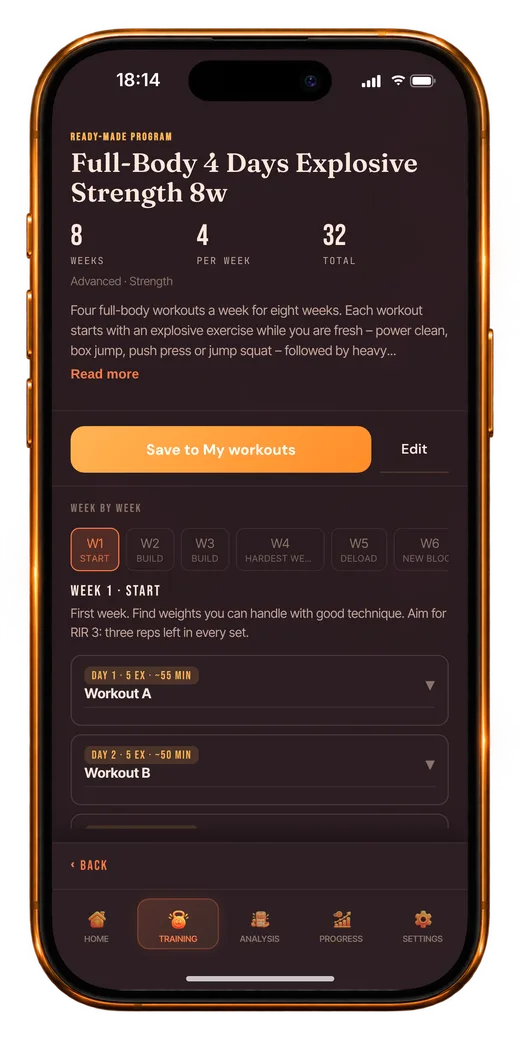
Write down every workout, ideally with how many reps you had left in the tank. TANK lets you log RIR for each set and track your progress week by week, and the training log is free. That makes it easier to see when it's time to push and when it's time to pull back.
Read next
Log your training, film your technique and see your progress. The workout log is free.
App StoreGoogle PlayFrequently asked questions
Is lifting weights twice a week enough?
Yes, two full-body sessions a week can take you a long way, especially early on. What matters is training consistently and gradually adding weight or reps.
Can I lift weights every day?
You can if you rotate muscle groups and keep each session fairly short, but it's rarely necessary. Most people feel and perform better with a few rest days a week.
How many rest days do I need?
A common starting point is at least one rest day between hard sessions for the same muscle group. Pay attention to how fresh you feel and how your weights are moving.
Is four days a week better than three?
Not automatically. Four sessions can be a good way to spread out more volume once you've been training a while, but three focused sessions beat four half-hearted ones.