How to Do Your First Pull-Up: Drills, an 8-Week Plan and Form Tips
Hanging under the bar and going nowhere is frustrating, but the first pull-up is a strength problem, and strength can be built. Here's what to train, in what order, and when to go for it.
If you've ever grabbed a bar, pulled as hard as you could and not moved at all, you're in good company. Figuring out how to do your first pull-up is one of the most common goals in the gym, and one of the most stubborn. It isn't about talent. It's about building a very specific kind of strength, and that can be done step by step.
Below you'll find the progressions that work, an eight-week plan, good form and the mistakes that keep people stuck.
Pull-up or chin-up?
A pull-up uses an overhand grip, palms facing away from you. A chin-up uses an underhand grip, palms facing you. Most people find the chin-up a little easier because the biceps can help more.
You can start with either. Just pick one grip as your main target for the next eight weeks and stick with it. The plan below works for both.
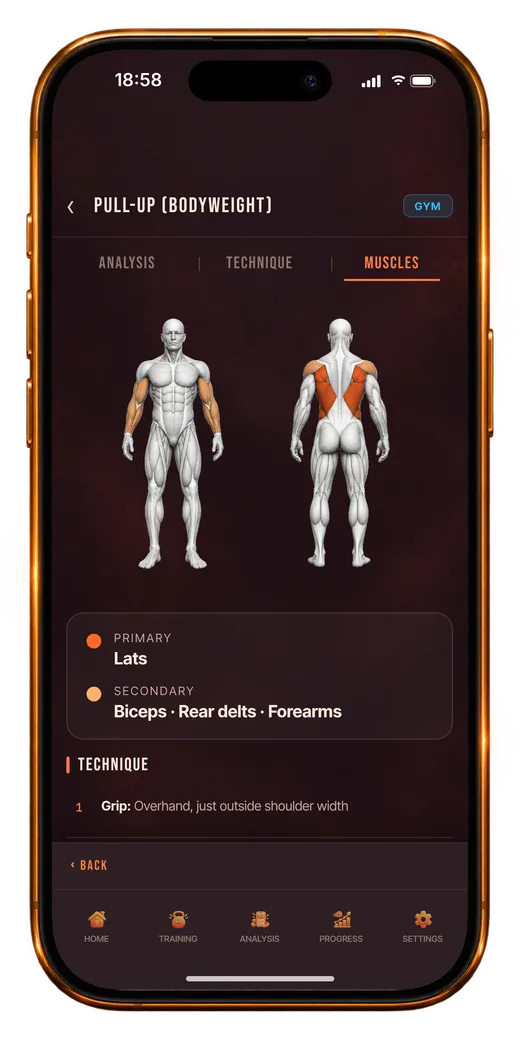
Why the first pull-up is so hard
In most lifts you start light and add weight over time. In a pull-up the starting weight is your own body, and you can't take any of it off without help. A few things make it tougher:
- Strength relative to body weight. What counts is how strong you are compared with how much you weigh. Two equally strong people can get very different results if one of them is heavier.
- Grip. Plenty of people let go before their back is anywhere near tired. A weak grip caps everything else.
- An unfamiliar movement. Your lats and the muscles around your shoulder blades rarely work this way in daily life. They need to learn to work together.
- The bottom position. The hardest part is usually the very start, pulling out of a dead hang. That's where most people stall.
Test where you're starting from
Run three quick tests first. They show which drills need the most attention and give you numbers to beat.
- Dead hang: Hang from the bar with straight arms for as long as you can. Time it.
- Negative: Step up on a box so your chin is over the bar, then lower yourself as slowly as you can. Time the descent.
- Top hold: Start with your chin over the bar and hold that position as long as possible.
If you can hang for around 30 seconds and control a three- to five-second negative, you have a solid base. If not, no problem. The plan starts gently.
The progressions that get you there
Dead hangs and scapular pulls
Hanging builds grip strength and gets your shoulders used to carrying your full body weight. Once that feels comfortable, add scapular pulls: from a dead hang, pull your shoulder blades down and slightly back so your body rises a little without bending your arms, then lower under control. That small movement is how every good pull-up begins.
Negative pull-ups
For most people, negatives are the single most useful drill. Jump or step up to the top position, then lower yourself as slowly as you can. Your muscles can handle more load while lowering than while lifting, so negatives let you train the full movement with your full body weight long before you can pull yourself up.
Aim for a three- to five-second descent at first and work up to eight to ten seconds. A few slow, controlled reps beat lots of fast drops. Expect sore muscles the first few times, so start with just a few sets.
Band-assisted and machine-assisted pull-ups
Loop a resistance band over the bar and put a foot or knee in it. The band helps most at the bottom, where you're weakest, and least at the top. Choose a band that lets you do five to eight full reps, and move to a lighter one when that gets easy.
An assisted pull-up machine works the same way, with steady help through the whole range. You can reduce the assistance in small steps, often 2.5 or 5 kg (roughly 5 or 10 lb) at a time, which makes progress easy to track.
Rows
Rows train the same muscles from a different angle and build the base strength pull-ups rely on. Good options:
- Inverted rows under a barbell set in a rack, or on rings. The more horizontal your body, the harder it gets.
- One-arm dumbbell rows with your other hand and knee on a bench.
- Lat pulldowns, ideally with the same grip you want to use for your pull-up.
An 8-week plan for your first pull-up
Train these drills two or three times a week with at least one rest day in between. The block takes 20 to 30 minutes and fits well at the start of a regular session, while you're fresh. If you need help building a full week around it, our guide to a workout plan for beginners is a good place to start.
| Weeks | Focus | Each session |
|---|---|---|
| 1–2 | Base and grip | Dead hang 3 × near max, scapular pulls 3 × 8, inverted rows 3 × 8–10 |
| 3–4 | Add negatives | Negatives 3 × 3 (3–5 seconds down), band-assisted 3 × 6–8, dumbbell rows 3 × 10 per side |
| 5–6 | More volume | Negatives 4 × 3 (5–8 seconds down), assisted with a lighter band 3 × 5–6, top hold 3 × max |
| 7–8 | Test | One attempt at a full pull-up first, then negatives 3 × 2–3 (8–10 seconds down) and assisted 2 × 5 |
Rest 1.5 to 2 minutes between sets of negatives and assisted reps, and about a minute between sets of rows and hangs. Make your full pull-up attempt at the start of sessions in weeks 7 and 8, when you're rested. If it doesn't happen yet, repeat weeks 5 to 8 for a few more weeks. Taking longer is completely normal.
Write down how long each negative lasts and which band or how much assistance you used. Seeing small wins add up keeps you going. TANK lets you log negatives and assisted reps and follow the trend session by session.
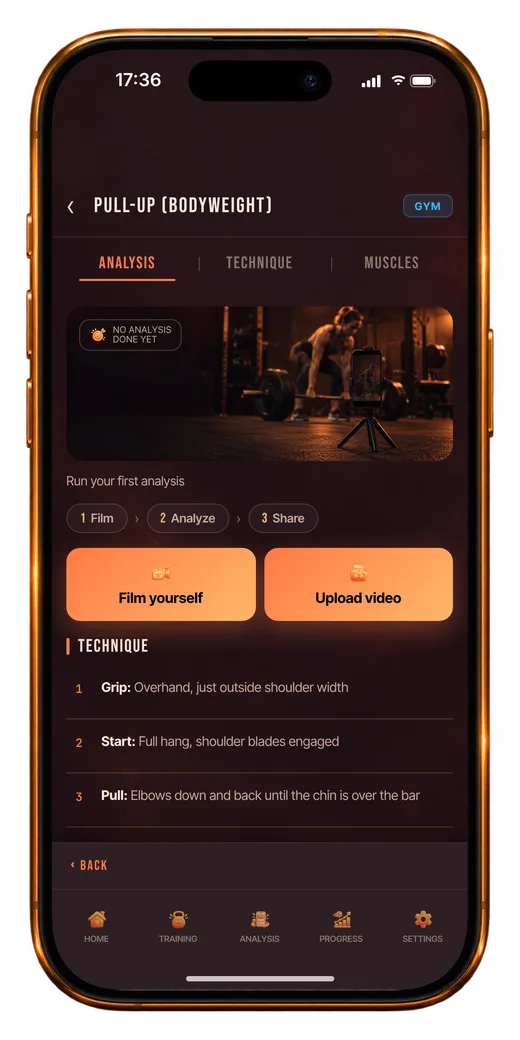
Pull-up form, step by step
- Grip: Hands about shoulder-width apart, thumbs wrapped around the bar.
- Start position: Hang with straight arms, brace your abs and lightly squeeze your glutes so your body moves as one piece and doesn't swing.
- Lead with the shoulder blades: Pull them down, just like in the scapular pulls, before your arms start to bend.
- Drive your elbows toward your hips: Think about pulling the bar down to your chest rather than pulling yourself up. Chest toward the bar.
- The top: Chin clears the top of the bar without craning your neck forward.
- The descent: Lower under control all the way to straight arms before the next rep.
To see what your reps really look like, film yourself from the side. TANK's AI technique analysis gives you a score from 0 to 100 and rep-by-rep tips, which makes it easier to spot things like losing tension at the bottom.
Common mistakes
- Half reps. If you never go back to straight arms, you never train the hardest part, and that's exactly where you need to get stronger.
- Only ever attempting. Hanging and struggling every session without any drills rarely leads anywhere. You mostly practice failing.
- A thick band for too long. The band should help, not do the work. Switch to a lighter one when you can do eight clean reps.
- Fast negatives. A one-second drop does very little. The slow braking is what builds strength.
- Kicking and swinging. Kicking your way up might get your chin over the bar, but as a beginner it won't build strength and it puts unnecessary stress on your shoulders.
- Too much, too often. Elbows and shoulders need recovery. If pain doesn't settle, cut back, and see a doctor or physical therapist if it persists.
After your first pull-up
Now the next phase begins. Do your full pull-ups first in the session, then top up with negatives and assisted reps. A good next target is three sets of one rep, then two, then three. Keep rowing, it's still the foundation.
Once you can do five to eight in a row, try the other grip or start adding a little weight with a dip belt. The first rep is the hardest.
Read next
Log your training, film your technique and see your progress. The workout log is free.
App StoreGoogle PlayFrequently asked questions
How long does it take to do your first pull-up?
It varies a lot. Many people who train the progressions two or three times a week see clear progress within six to eight weeks, but it can take longer if you're heavier or new to strength training.
Are chin-ups easier than pull-ups?
For most people, yes, because the underhand grip lets the biceps help more. Try both and start with whichever feels easier.
Can I train for a pull-up at home?
Yes. With a sturdy doorway pull-up bar you can do dead hangs, negatives and band-assisted reps, and you can row with dumbbells or a loaded backpack.
How often should I train pull-ups as a beginner?
Two or three times a week with at least one rest day in between is enough for most people. More than that usually just leaves your elbows tired.
Do I need to lose weight to do a pull-up?
Not necessarily. What matters is your strength relative to your body weight, and you can improve that by getting stronger.