Couch to 5K plan: an 8-week run-walk program for total beginners
You don't need to be a runner to start. This 8-week couch to 5K plan mixes walking and running so you build up to 5 km step by step, without gritting your teeth through every session.
The hardest part of any couch to 5K plan isn't the running. It's holding back. Your breathing usually catches up faster than you expect, but your legs need time to get used to the pounding. Most new runners who quit do so in the first few weeks, and nearly always for the same reason: they went too fast, too far or too often before their body was ready.
This plan gets around that by mixing running and walking. You start with one-minute jogs and add a little each week. After eight weeks, the goal is to run 5 km (3.1 miles) at an easy pace without walking. If you can already jog for 20 minutes straight, feel free to jump in at week 5 or 6.
How the plan works
You run three times a week with at least one rest day between sessions. Monday, Wednesday and Saturday is a classic setup, but pick whatever days fit your life. What matters is that the sessions actually happen.
Every session starts with a five-minute brisk walk and ends with a five-minute easy walk. They aren't listed in the table, but they're part of the deal. The warm-up makes the first running intervals feel easier, and the cool-down lets your heart rate settle gradually.
- Run means an easy jog at a pace where you can still talk in full sentences.
- Walk means a brisk walk. Keep moving; don't stop and stand still.
- Session 3 is the slightly tougher run of the week and prepares you for the next one. If it's too much, repeat session 1 instead.
The 8-week couch to 5K plan
| Week | Sessions 1 and 2 | Session 3 |
|---|---|---|
| 1 | 8 × (1 min run, 1.5 min walk) | 8 × (1 min run, 1.5 min walk) |
| 2 | 6 × (2 min run, 1.5 min walk) | 5 × (3 min run, 1.5 min walk) |
| 3 | 5 × (3 min run, 1.5 min walk) | 4 × (4 min run, 1.5 min walk) |
| 4 | 4 × (5 min run, 2 min walk) | 3 × (6 min run, 2 min walk) |
| 5 | 3 × (8 min run, 2 min walk) | 2 × (10 min run, 2 min walk) |
| 6 | 2 × (12 min run, 2 min walk) | 18 min continuous run |
| 7 | 20 min continuous run | 25 min continuous run |
| 8 | Session 1: 25 min run. Session 2: 30 min run | 5 km at an easy pace |
The plan is based on time, not distance. That way you don't have to measure a route, and you won't be tempted to speed up to cover more ground. In week 8, the final session is your first 5K, however long it takes.
If you miss a session
One missed run is no big deal. Pick up where you left off and push the rest of the plan back. If you've been out for more than a week, say with a cold, go back one week and build up again from there.
Gear: what you actually need
Less than the running stores would like you to believe.
- Shoes: a pair of running shoes that feel comfortable the moment you try them on. There's no single best shoe for everyone, so go by feel. If the soles on your current pair are worn flat, it may be time for new ones.
- Clothes: technical fabric that doesn't soak up sweat, especially in cold weather. Dress as if it's a few degrees warmer than it is; you'll heat up within minutes.
- Visibility: if you run early in the morning or after dark, wear something reflective or a headlamp.
- Watch or phone: handy but not essential. You just need something to time the intervals so you're not counting in your head.
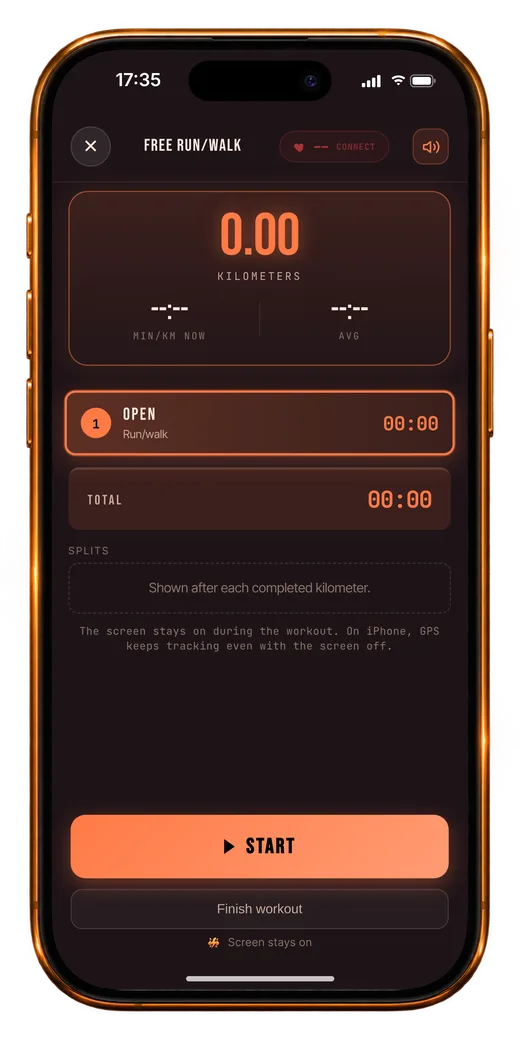
If you run with your phone, TANK tracks the route with GPS, handles intervals and reads out your time and pace at every kilometer, so the phone can stay in your pocket.
How fast should you run?
Slower than you think. "Slow down" is the most common advice given to new runners, and it applies to almost everyone. Use the talk test: if you can say a whole sentence without gasping, your pace is right. If you can only get out a couple of words at a time, you're going too fast.
It may feel ridiculously slow, barely quicker than a brisk walk. That's completely fine. Aerobic fitness is built at an easy effort, and an easy effort is what gets you through all eight weeks.
What your 5K time tells you
Nothing important, at least not yet. At a pace of 7:30 per km (about 12:04 per mile), 5 km takes 37.5 minutes. At 8:00 per km (about 12:52 per mile), it takes 40 minutes. Both are a perfectly respectable first 5K. You get faster by running consistently for months, not by forcing the pace in the first few weeks.
Once you can run 5 km, you can start working on speed, for example with one short interval session a week. Just wait until the base is solid.
When a session feels too hard
Everyone has runs where their legs feel like lead. Poor sleep, stress, heat or a long week at work all show up the moment you start running. It doesn't mean the plan is wrong or that running isn't for you. Try this, in order:
- Slow down. Most of the time, that's all it takes. Jog so slowly it almost feels like walking.
- Walk a bit longer. Add 30 seconds to each walk break and finish the session anyway.
- Repeat the session. Do the same workout next time instead of moving on.
- Repeat the week. If the whole week was a grind, do it again. That's common, and finishing in ten weeks instead of eight is still finishing.
Learn to tell tiredness from pain. Heavy legs and heavy breathing come with the territory. Sharp pain, pain that gets worse as you run or pain that makes you limp is a signal to stop. Rest for a few days, and if it doesn't settle, or you're worried, see a doctor or a physical therapist.
Common beginner mistakes
Running too fast
The classic. You charge through the intervals, run out of gas halfway and decide you're just not a runner. Slow down and the plan gets a whole lot easier.
Skipping weeks
If week 2 feels easy, it's tempting to jump to week 4. But your heart and lungs often adapt faster than your tendons, joints and bones, which need more time to get used to the impact. Stick to the order even when it feels easy.
Running every day
More isn't better at the start. Rest days are when your body adapts. If you want to move more, walk, cycle or do some strength work on your days off.
Skipping strength work
Strong legs and hips handle running better. Two short strength sessions a week with squats, lunges, calf raises and planks make a great complement. If you'd like a ready-made routine, this workout plan for beginners fits nicely alongside your runs.
New shoes on race day
If you've signed up for a local 5K at the end of the plan, wear shoes and clothes you've already tested. Race day is not the time to try anything new.
After week 8
Once you've run your first 5K, you have a base to build on. Keep running three times a week and let one run get a little longer over time. If you want to get faster, swap one session for short intervals. And if you simply want to keep running 5K because it feels good, that's just as worthy a goal.
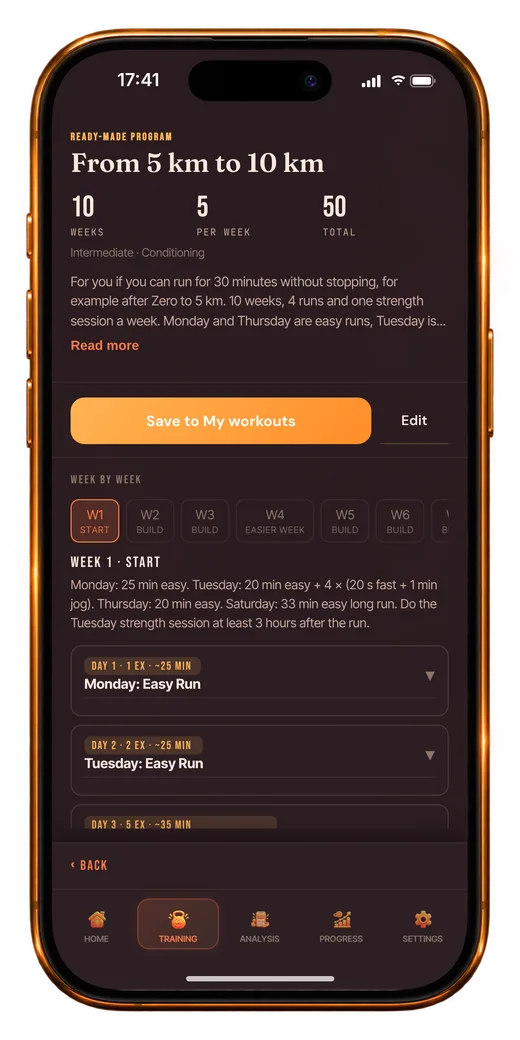
Log your runs so you can see how far you've come. It's surprisingly motivating on days when you don't feel like heading out. The training log in TANK is free and shows the time, distance and pace for every run.
Read next
Log your training, film your technique and see your progress. The workout log is free.
App StoreGoogle PlayFrequently asked questions
How long does it take to go from couch to 5K?
With this plan, eight weeks at three sessions a week. Many people repeat a week or two along the way, and that's completely fine.
What is a good 5K time for a beginner?
Any time where you run the whole way is a good first 5K. At the start, an easy, conversational pace matters more than the clock.
Can I run every day as a beginner?
It's better to start with three runs a week and rest days in between. Your body adapts on the rest days.
What should I do if my knees or shins hurt?
Stop if the pain is sharp, getting worse or making you limp, and rest for a few days. If it doesn't settle, see a doctor or physical therapist.
Do I need expensive running shoes?
No. Choose a pair that feels comfortable. Price says little about how well a shoe suits you.