The Best Glute Exercises at the Gym: Form, a Sample Workout and Progression
You don't need thirty variations to build stronger glutes. Here are the gym exercises that deliver the most, how to do them properly and a ready-made workout with a clear plan for progress.
The best glute exercises aren't secret, and they aren't complicated. A handful of well-chosen lifts that load your glutes from different angles, done with solid form and gradually heavier weights, will beat an endless list of band variations every time. This guide covers how your glutes work, which gym exercises give you the most return, a sample workout, how often to train and how to keep progressing.
Your glutes in a nutshell
You have three glute muscles on each side. Gluteus maximus is the big one. It extends the hip, driving your thigh back and bringing you upright from a bent-over position. It's what powers you out of the bottom of a squat, up a steep hill or through the lockout of a deadlift.
Gluteus medius and gluteus minimus sit higher up and towards the side. They move your leg out sideways and, more importantly, keep your pelvis level whenever you stand on one leg. Every running stride is essentially a quick single-leg exercise for them.
The takeaway: a good glute program mixes heavy hip extension with single-leg work and a bit of side-to-side movement.
The best glute exercises at the gym
These made the list because they're easy to load progressively, easy to track and, together, cover everything your glutes do. You don't need all of them in one session.
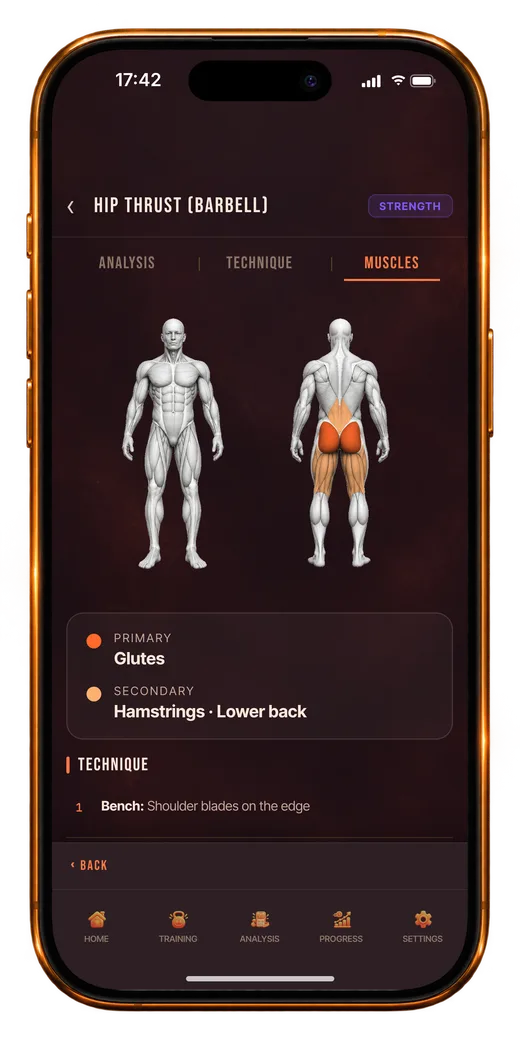
Barbell hip thrust
The hip thrust challenges your glutes hardest at the top, exactly where most other lifts get easier. Sit on the floor with your upper back against a bench and a padded barbell across your hips.
- Set your feet about hip-width apart so your shins are close to vertical at the top.
- Tuck your chin slightly and keep your eyes forward; your ribcage will follow.
- Drive through your heels until your hips line up with your knees and shoulders, then squeeze for a second.
- Don't arch your lower back to finish the rep. The movement should end at the hips.
Romanian deadlift
The Romanian deadlift (RDL) works your glutes and hamstrings in a stretched position, which makes it a natural partner for the hip thrust. Start standing with the bar in your hands and a soft bend in your knees.
- Push your hips back as if you're closing a car door with your backside. Your knee angle barely changes.
- Keep the bar close to your thighs and your back neutral.
- Lower until you feel a strong stretch in your hamstrings, usually just below the knee, then drive your hips forward to stand up.
How low you go depends on your mobility. Stopping higher with a flat back beats touching the floor with a rounded one.
Bulgarian split squat
Few exercises are as unpopular or as effective. With your back foot up on a bench, one leg does almost all the work while the smaller glute muscles fight to keep your hips level.
- Place your front foot far enough forward that you can drop straight down without your heel lifting.
- A slight forward lean shifts more of the work to your glutes. Staying bolt upright hits your quads more.
- Start with bodyweight or light dumbbells. For the first few weeks, balance is usually the limit, not strength.
Step-ups
Use a box or bench at roughly knee height. Plant your whole foot on top and let the front leg do the work. Step-ups have plenty of carryover to running, stairs and everyday life, and they're easy to learn.
The classic cheat is pushing off the back foot. Try keeping only the heel of your back foot on the floor at the start. And control the way down; it's half the exercise.
Cable exercises
Cables give you steady tension through the whole range and work well as finishers. Two moves cover most of what you need:
- Cable kickback: strap on an ankle cuff, lean slightly into the machine and drive your leg back. Stop before your lower back starts to arch.
- Cable hip abduction: stand side-on to the stack and move your outside leg out to the side. Keep your torso still and your toes pointing forward to target the glute medius.
Other solid options
- Deep squats load the glutes most near the bottom of the movement.
- 45-degree back extensions turn into a glute exercise rather than a lower-back one if you round your upper back slightly and focus on extending the hips.
- The hip abduction machine is an easy way to rack up volume for the side of your glutes.
- Glute bridges on the floor are a good starting point if barbell hip thrusts still feel awkward.
A sample glute workout
This session takes around 50 minutes. Use it as a standalone lower-body day or split it across two shorter workouts. Pick weights that leave one to three reps in reserve on every set.
| Exercise | Sets | Reps | Rest |
|---|---|---|---|
| Barbell hip thrust | 4 | 6–10 | 2–3 min |
| Romanian deadlift | 3 | 8–10 | 2 min |
| Bulgarian split squat | 3 per leg | 8–12 | 90 s |
| Step-up | 2 per leg | 10–12 | 60–90 s |
| Cable hip abduction | 2 per leg | 12–15 | 60 s |
| Cable kickback | 2 per leg | 12–15 | 60 s |
Do the heaviest lifts first while you're fresh, and warm up with a few light sets of hip thrusts and RDLs before your working sets.
How often should you train glutes?
Two to three sessions a week works well for most people. Glutes tend to recover fairly quickly, and several moderate sessions usually get you further than one brutal one that leaves you sore for days.
A simple approach is to include one heavy hip-extension lift on every lower-body day and spread your single-leg and cable work across the week. On a full-body program, your glutes get trained several times a week by default. If you're not sure which setup suits you, our guide on split versus full-body training walks you through it.
If you run or train for HYROX, keep your heavy glute day away from the day before intervals or a long run. Light single-leg and cable work usually sits fine alongside running.
Progression: how to keep getting stronger
Muscles adapt when the work gradually increases. The simplest system is double progression:
- Choose a rep range, say 6–10 for hip thrusts.
- Start with a weight you can lift for 6 reps on every set.
- Add reps from session to session until you hit 10 on every set.
- Add 2.5–5 kg (5–10 lb) and start again at the bottom of the range.
Single-leg and cable exercises progress more slowly. There you can also add a set, slow down the lowering phase or pause for a second in the hardest position.
Whatever you do, write it down, or you'll be guessing next time. TANK logs weight and reps for every set, so you can see what you lifted last session before you start.
Common glute training mistakes
- Arching instead of extending. In hip thrusts and kickbacks it's easy to keep the movement going through your lower back. Stop when your hips are straight.
- Staying light for too long. Bands and bodyweight are great for learning the movement, but your glutes need heavier loads to keep developing.
- Only one type of exercise. Hip thrusts every session with no single-leg work leaves the side of your glutes under-trained.
- Program hopping. Stick with your main lifts for at least six to eight weeks so you can actually tell whether you're getting stronger.
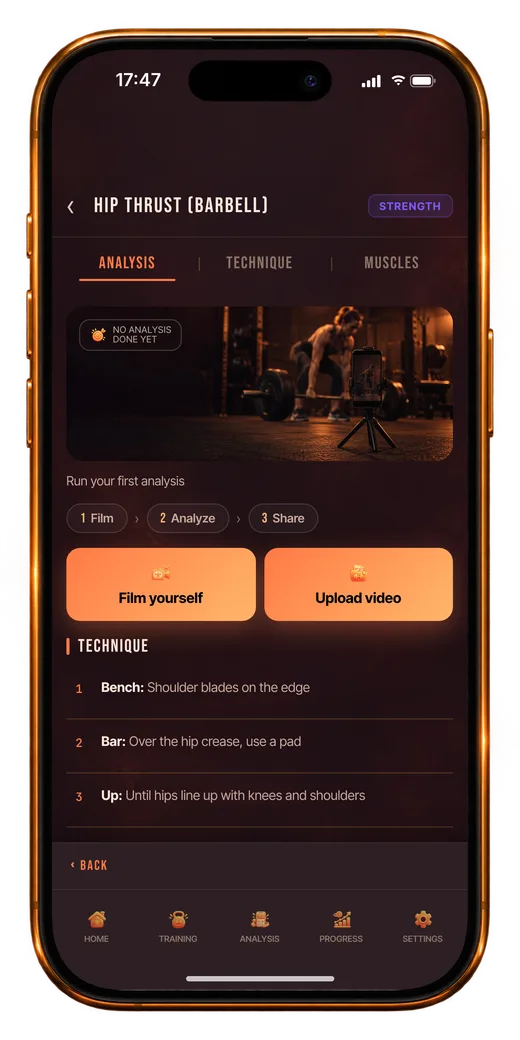
If you're unsure whether your hip thrust or RDL form is right, film yourself from the side. With the AI form check in TANK, you record the exercise and get a score from 0 to 100 plus rep-by-rep tips.
Read next
Log your training, film your technique and see your progress. The workout log is free.
App StoreGoogle PlayFrequently asked questions
How many times a week should I train glutes?
Two to three times a week suits most people. Several moderate sessions usually work better than one very hard one.
What is the single best glute exercise?
There isn't one. Hip thrusts and Romanian deadlifts complement each other well, and a single-leg exercise like the Bulgarian split squat covers the rest.
Why do I feel Bulgarian split squats mostly in my quads?
Your front foot is probably too close to the bench or your torso is completely upright. Take a longer stance and lean forward slightly to shift more work to your glutes.
Can I train glutes without a barbell?
Yes. Dumbbells, cables, the abduction machine and single-leg exercises go a long way, as long as you keep increasing the load over time.