10 Core Exercises That Carry Over to Lifting and Running
A strong core is less about a visible six-pack and more about keeping your trunk steady while you lift, run and carry. Here are ten exercises, a ready-made workout and a simple way to make it harder over time.
For years, core training meant sit-ups and crunches. But if you lift heavy or run long, what matters is something else: your ability to keep your trunk still while forces try to bend, twist or tip it. This guide explains what the core actually is, why it matters, and which core exercises give you the best return. You also get a ready-made workout and a simple model for progressing it.
What is the core?
Your core is more than your abs. The term usually covers the whole midsection between ribcage and hips: the rectus abdominis, the obliques, the deep transverse abdominis, the muscles running along your spine, the diaphragm and the pelvic floor. Your glutes and hip muscles work closely with all of them.
Together they act like a pressurised cylinder around your spine. In training, their most important job is often not to create movement but to resist it. That is why many coaches sort core exercises into three groups:
- Anti-extension: resisting your lower back arching, as in planks and dead bugs.
- Anti-rotation: resisting your trunk twisting, as in the Pallof press and bird dog.
- Anti-lateral flexion: resisting your trunk tipping sideways, as in side planks and suitcase carries.
Why your core matters for lifting and running
In the gym
In squats, deadlifts and presses, the force from your legs and hips has to reach the bar without leaking out along the way. A core you can brace hard makes it easier to hold a solid position through every rep, especially when the weight is heavy or fatigue sets in.
On the road
Every running stride is a brief single-leg stance in which your pelvis should stay reasonably steady while your arms and legs swing. A strong core can help you hold your posture as you tire, which many runners notice late in long runs and races. Core work does not replace running, but it is a useful addition.
10 core exercises worth doing
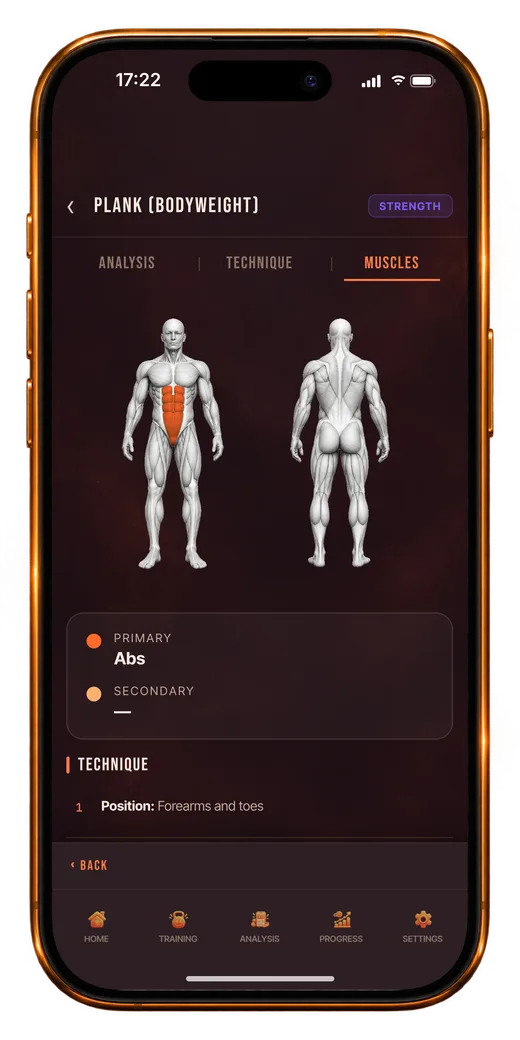
1. Plank
Support yourself on your forearms and toes, body in a straight line from head to heels. Squeeze your glutes and draw your belly button gently in so your lower back does not sag. A shorter hold with perfect form beats a long one with drooping hips.
2. Side plank
Lie on your side, propped on one forearm and the outside edge of your foot. Lift your hips until your body forms a straight line and hold. Start with your knees down if you need to.
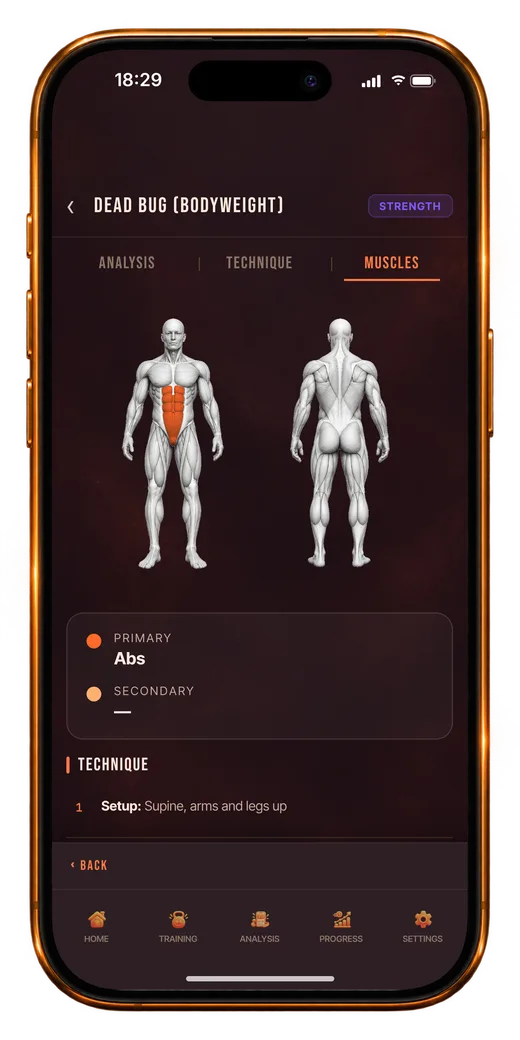
3. Dead bug
Lie on your back with your arms straight up and hips and knees at 90 degrees. Press your lower back into the floor and slowly extend the opposite arm and leg without letting your back lift. Breathe out as you reach, return and switch sides.
4. Bird dog
Start on all fours. Reach the opposite arm and leg out until they line up with your body, hold for a second and return. Imagine a glass of water on your lower back that must not spill.
5. Pallof press
Stand side-on to a cable machine or a band anchored at waist height. Hold the handle at your chest, press straight out and keep your arms extended for one or two seconds while the band tries to rotate you. Do the same number of reps facing each way.
6. Hanging knee raise
Hang from a bar with straight arms. Bring your knees towards your chest by curling your pelvis up, rather than just lifting your legs, then lower slowly. Avoid swinging. If grip is the limit, do them supported on your forearms in a captain's chair.
7. Ab wheel rollout
Kneel with the wheel in front of you. Roll out as far as you can without your lower back sagging, then pull yourself back using your abs. Start with short rollouts towards a wall that acts as a stop.
8. Hollow hold
Lie on your back, press your lower back into the floor and lift your shoulders and legs slightly off the ground so your body forms a shallow curve. The further you reach your arms and legs, the harder it gets.
9. Farmer's walk
Pick up a heavy dumbbell or kettlebell in each hand and walk tall with your shoulders down and your trunk braced. A simple exercise that trains core, grip and posture all at once.
10. Suitcase carry
Like the farmer's walk, but with a weight in one hand only. Now your core has to work hard to stop you leaning to the side. Walk steadily, keep your shoulders level and swap hands.
A ready-made core workout
This session takes around 15 to 20 minutes and works well after a strength session or on its own. Pair the exercises (alternate A1 and A2, and so on) and rest 45 to 60 seconds between sets.
| Exercise | Sets | Reps or time |
|---|---|---|
| A1. Dead bug | 3 | 6–8 per side |
| A2. Pallof press | 3 | 8–10 per side |
| B1. Side plank | 3 | 20–30 seconds per side |
| B2. Hanging knee raise | 3 | 8–12 |
| C. Suitcase carry | 3 | 20–30 m per hand |
Two or three core sessions a week is plenty for most people. Your core also does a lot of work in the big compound lifts, so treat this as a supplement. Log your times, weights and distances so you can see progress. In TANK, these core exercises are part of the 961 exercises in the training log, and you can record both hold times for planks and load for carries.
How to make it harder
Your core responds to the same principle as the rest of your body: a gradually bigger challenge. Read more about progressive overload if you want the full picture. With core exercises you have several levers to pull:
- Longer lever: reach your arms out in the plank or your legs out in the hollow hold.
- Smaller base: lift one leg or one arm during a plank.
- More load: a stronger band for the Pallof press, heavier weights for carries.
- Slower tempo and pauses: hold two seconds at full extension in the dead bug and bird dog.
- More time or reps: add in small steps, such as five seconds or one rep at a time.
Change one thing at a time. Once you can hit the top of the range with good control on every set, move up.
Common mistakes
- Chasing plank times: a five-minute plank with a sagging back mostly trains patience.
- Holding your breath: learn to breathe while braced, because you need that under heavy loads and on the run.
- Only training the front: mix exercises from all three groups.
- Fast, swinging reps: control is the point, not the rep count.
If you have back pain or are unsure what you can handle, speak to a doctor or physiotherapist before ramping up your core training.
Read next
Log your training, film your technique and see your progress. The workout log is free.
App StoreGoogle PlayFrequently asked questions
How often should I train my core?
Two or three times a week is enough for most people, ideally as a short add-on after a strength or running session. Your core also works hard in squats and deadlifts.
Will core exercises give me a flat stomach?
Core training makes the muscles stronger, but how visible your abs are depends mainly on body fat. Spot reduction does not work.
What are the best core exercises for runners?
There is no single best one, but moves that challenge single-leg or anti-rotation stability, such as bird dogs, Pallof presses, side planks and suitcase carries, suit runners well.
How long should I hold a plank?
As long as you can keep a straight, controlled position. When your form slips, stop and do more short sets or a harder variation instead.