Overhead Press Form: How to Press Strict Without Overarching
The standing overhead press is one of the most honest lifts in the gym: no bench to lean on, just you and the bar. Here's how to set up, where the bar should travel, what usually goes wrong and how to keep adding weight.
The standing barbell press, also called the strict press or military press, is a lift where good overhead press form shows immediately. Stand tall and tight, and the bar travels in a straight line. Get sloppy, and you lean back, the bar drifts forward and your lower back pays for it. This guide covers the setup, bracing, breathing, the bar path, common mistakes, dumbbell variations and how to keep progressing without your technique falling apart.
What counts as a strict overhead press
In a strict press you push a barbell from the front of your shoulders to straight arms overhead, with no help from your legs. Add a small dip and drive with the knees and it becomes a push press, a useful lift in its own right but a different one. The strict version builds shoulder and triceps strength and forces your whole body, from the feet up, to stay rigid.
Setting up
Bar height
Set the hooks so the bar sits roughly at the level of your upper chest. That lets you step under it, bend your knees slightly and stand up with the bar already in the starting position. Set it too high and you'll be on your toes trying to get it out.
Grip
Take a grip just outside shoulder width. From the front and the side, your forearms should be roughly vertical with the bar resting on your shoulders, elbows slightly in front of the bar. Set the bar low in your palm, close to the wrist, so it sits directly over your forearm bones. Squeeze hard and keep your thumbs wrapped.
Stance and start position
Stand with your feet about hip width apart, similar to how you'd stand for a vertical jump. The bar rests on the front of your shoulders or upper chest, not out in your hands. Take one or two short steps back from the rack and get still before the first rep.
Brace your core and glutes
What separates a solid overhead press from a wobbly one is the tension below your shoulders. Think of yourself as a rigid column the arms press from.
- Glutes: squeeze hard. It locks your pelvis in place and makes it harder to overarch.
- Abs: brace as if you're about to take a punch, and keep your ribs down rather than letting your chest flare.
- Legs: knees straight, pushing the whole foot into the floor.
A little lean is unavoidable to get the bar past your face. It should come from the ankles with your body in one straight line, not from a big bend in the lower back.
Breathing
Breathe in at the start, brace, and hold that breath through the press. Exhale at lockout or once the bar is back on your shoulders, then take a fresh breath for the next rep. If you have high blood pressure, a heart condition or another health issue, check with your doctor about holding your breath on heavy lifts.
The bar path: straight up, head out of the way
You want the bar to travel in as straight a vertical line as possible, roughly over mid-foot. The problem is that your face is in the way. The fix is to move your head, not the bar.
- Tuck your chin and pull your head back slightly as you start, so the bar can travel straight up past your chin and nose.
- Press straight up with your elbows under or slightly in front of the bar.
- Bring your head through once the bar passes your forehead, pushing it forward into the "window" between your arms.
- Lock out with straight arms and the bar over your shoulders, hips and mid-foot. A slight shrug toward your ears at the top helps finish the rep.
- Lower under control along the same path: head back a touch, bar down to your shoulders.
Seen from the side at lockout, you should be able to draw a vertical line through the bar, your ears, shoulders, hips and ankles.
Common overhead press mistakes and fixes
| Mistake | What it looks like | Fix |
|---|---|---|
| Overarching | Hips shoot forward and the lower back bends to get the bar up. | Squeeze your glutes, keep your ribs down and lower the weight until you can press it strict. |
| Bar looping around the face | The bar swings forward to dodge your head and ends up in front of you. | Move your head back instead, then bring it through once the bar clears your forehead. |
| Elbows behind the bar | Forearms tilt and the bar gets pushed forward from the start. | Bring your elbows slightly in front of the bar before you press. |
| Soft lockout | Arms bent at the top and the bar still in front of your head. | Press all the way and bring your head forward under the bar. |
| Using your legs | Little knee dips add momentum, usually when it gets heavy. | Lock your knees. If you want leg drive, train the push press as a separate lift. |
| Wrists bent back | The bar sits in your fingers and your wrists fold. | Move the bar closer to the base of your palm so it rests over your forearm. |
If you can't get your arms overhead
If you can't reach straight arms overhead without a big arch, shoulder or upper-back mobility may be the limit. Start with dumbbells or a landmine press, which give you more freedom, and work gradually toward the full range. If your shoulder hurts, don't press through the pain, and see a doctor or physiotherapist if it doesn't settle.
Safety
Press inside a rack with the safety pins set just below your starting position if you can. If you miss a rep, lower the bar under control back to your shoulders and rack it. Never let the bar drop behind your head. Leave a rep or two in reserve on most sets; that's plenty to get stronger.
Dumbbell variations
Dumbbells are a good complement to the barbell, and sometimes a better place to start.
- Seated dumbbell press: the back support removes much of the balance demand, which makes it handy for building shoulder volume.
- Standing dumbbell press: asks more of your core and lets each arm find its own path.
- Single-arm press: one dumbbell at a time challenges your trunk not to lean sideways and exposes left-right differences.
- Landmine press: the bar travels up at an angle instead of straight overhead, a gentler option if overhead pressing bothers you.
With dumbbells you can also turn your palms slightly inward, which many people find more comfortable for their shoulders.
Film yourself from the side
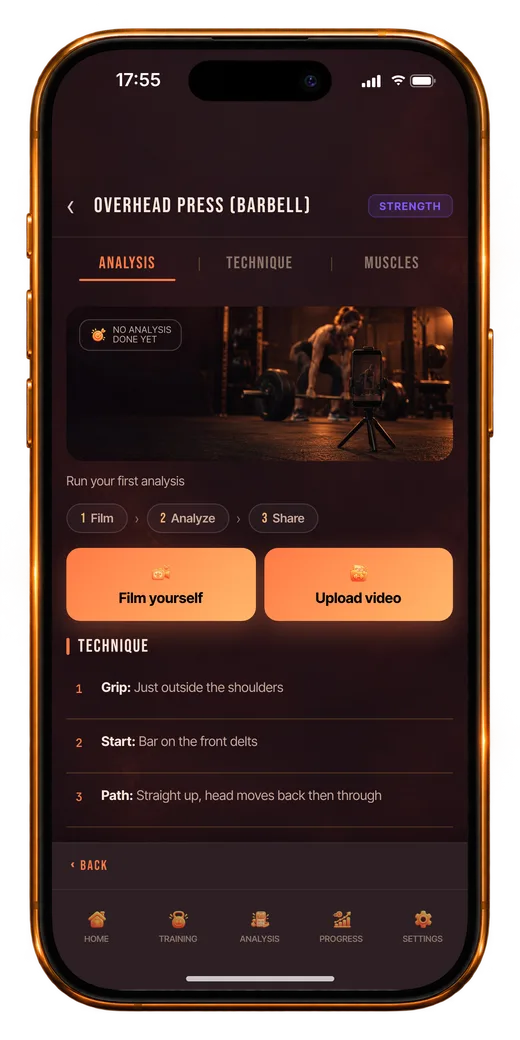
Put your phone at waist height, square to the side, two to three metres away, with your whole body and the bar in frame. Look for three things: does the bar move in a straight line, are you stacked vertically at lockout, and how far are you leaning back? With TANK you can film the set and get an AI technique analysis with a 0–100 score and rep-by-rep tips, so you can see whether your form holds when the weight gets heavy.
How to progress your overhead press
The overhead press is usually the slowest lift to move, because the muscles involved are smaller. Small jumps work best: 1–2.5 kg (2.5–5 lb) at a time, or less with fractional plates. A simple approach is double progression: pick a rep range such as 5–8 and only add weight once you hit the top of the range on every set. The principle is explained in our guide to progressive overload.
Log your sets, reps and how many reps you had left. TANK lets you record RIR on every set, which makes it easier to see when it's time to add weight.
Read next
Log your training, film your technique and see your progress. The workout log is free.
App StoreGoogle PlayFrequently asked questions
Is the overhead press the same as the military press?
Mostly, yes. Military press usually refers to the strict standing barbell press, while overhead press is a broader term that also covers seated and dumbbell versions.
Should I lean back when I overhead press?
A slight lean is needed to get the bar past your face. A big arch in the lower back means the weight is too heavy or you're not braced.
Is seated or standing overhead press better?
Both work. Standing asks more of your core and balance, seated makes it easier to focus on the shoulders. Many lifters use both at different times.
How wide should my overhead press grip be?
Just outside shoulder width, so your forearms are roughly vertical with the bar resting on your shoulders.